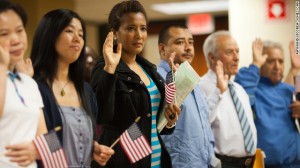
By: USCIS Release Date: June 30, 2016          Citizenship candidates take the Oath at public parks and historic landmarks nationwide WASHINGTON—U.S. Citizenship and Immigration Services (USCIS) will celebrate the 240th  anniversary of the Declaration of Independence, and our nation’s birthday, by welcoming more than 7,000 new U.S. citizens during nearly 100 naturalization ceremonies across the country between […]

WASHINGTON – On May 27th, the U.S. Department of Homeland Security published amended regulations on optional practical training (OPT) for certain international students with science, technology, engineering and mathematics (STEM) degrees from U.S. institutions of higher education. The amended regulations will go into effect May 10. Under the new regulations, certain students can apply to […]

By Martha C. White Immigration, and especially illegal immigration, is a major political and cultural flashpoint. Surprising new findings from Harvard University researchers will do little to change that, but they do provide some context for dispelling some claims while reinforcing others. The biggest myth that can be put to bed by the findings is […]

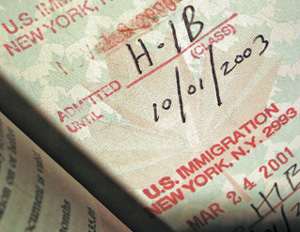
By: U.S. Citizenship and Immigration Services The Consolidated Appropriations Act, 2016 (Public Law 114-113), signed into law by President Obama on December 18, 2015, increases fees for certain H-1B and L-1 petitioners. These petitioners must submit an additional fee of $4,000 for certain H-1B petitions and $4,500 for certain L-1A and L-1B petitions postmarked on […]

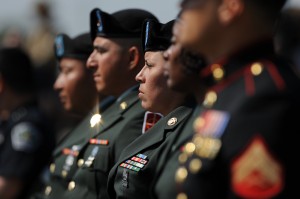
Written by Amanda Peterson Each year, roughly 8,000 immigrants join the U.S. military, bringing linguistic skills and cultural diversity that enrich each branch of the Armed Forces. Nearly 65,000 service members have become naturalized U.S. citizens since September 2001, but there are still limits that prevent young immigrants who want to serve from doing so. […]

By Noah Buhayar Every year, U.S. embassies around the world have a delicate chore: Finding presents to give foreign officials and other Department of State contacts in their region. It’s best if the presents are uniquely American and not too expensive. Above all else, they have to be culturally appropriate. No diplomat wants to create […]